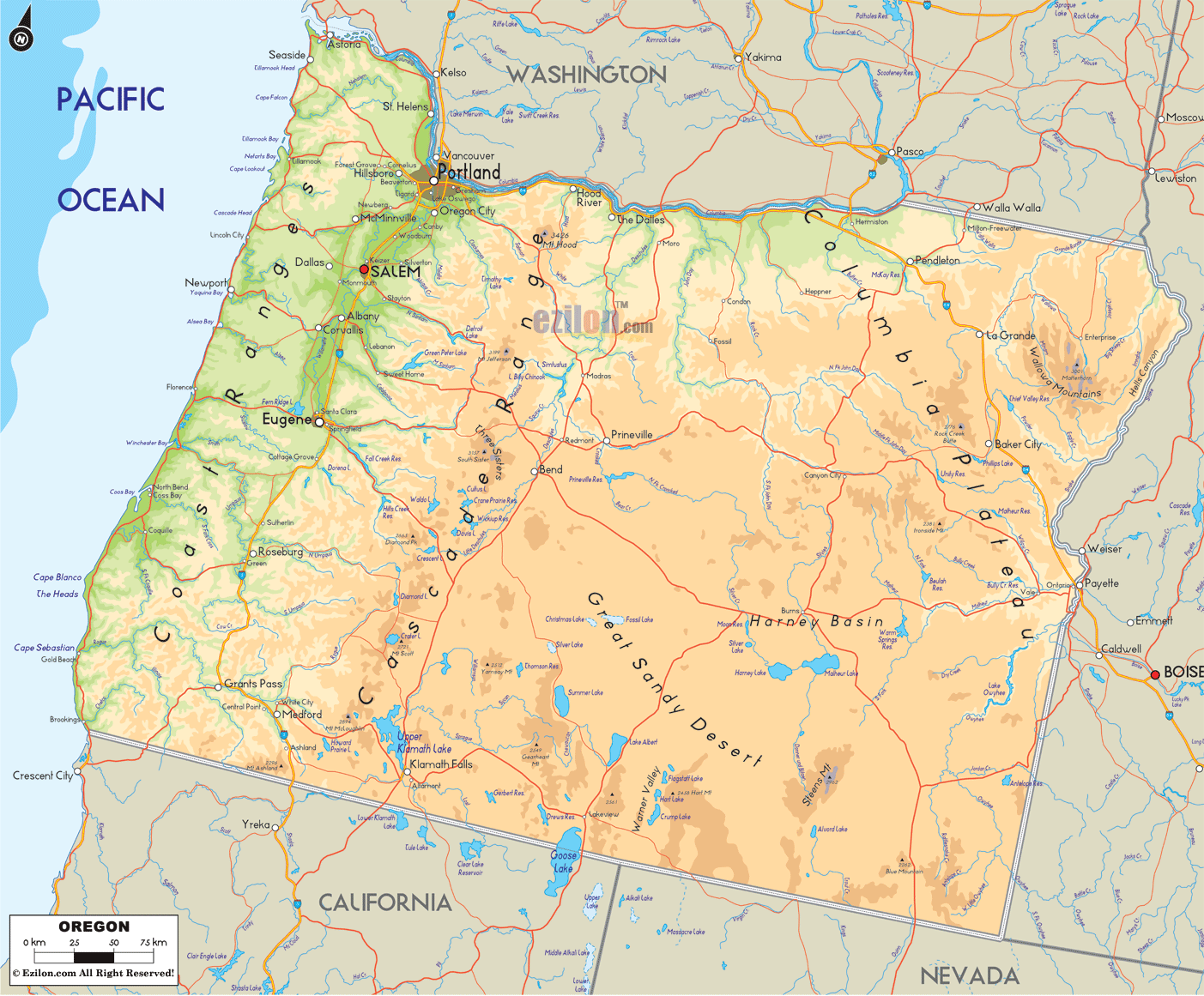
Description: The Physical map of Oregon State, USA showing major geographical features such as rivers, lakes, mountains, topography and land formations.

Detailed Physical map of Oregon with elevations and other topographic features such as mountains, rivers and lakes. Oregon borders Washington, Idaho, Nevada and California. On our detailed map, you can see how green, shaded relief hugs the Pacific coast, how the Cascade Range forms a bold north-south spine, and how the land fades into warm colors as it slopes toward the dry interior. For county boundaries, cities, and roads, see our County and Road Map of Oregon.
Oregon touches the Pacific Ocean on the west, Washington to the north across the Columbia River, Idaho to the northeast, Nevada to the southeast, and California to the south. This frame helps map readers understand why Oregon acts as a bridge between the rainy Northwest and the arid Great Basin and Snake River country.
Starting at the left edge of our map, the Pacific Ocean's blue meets a jagged shoreline. Towns such as Seaside, Astoria, Newport, Brookings, and Crescent City, just off the map edge, show how communities cling to small harbors and river mouths. The coastline is marked with names like Cape Blanco, Cape Sebastian, and Cape Foulweather, headlands that stand out where resistant rock meets surf.
This coastal strip is narrow, and the detailed map shows only a short distance between the ocean and the first belt of hills. Highways and rivers snake north and south along the lowlands, squeezed between waves and steep slopes, which explains why travel along the Oregon coast follows a single main route.
Immediately inland, the Coast Range appears as a band of green textured shading. Peaks and ridges run from the California line past Coos Bay, Roseburg, Corvallis, and McMinnville toward the Columbia River. On our geographical map of Oregon, you can trace valley after valley cut through this range by rivers flowing west, such as the Umpqua and smaller coastal streams.
Settlements like Grants Pass, Roseburg, and Dallas sit in more expansive valleys where hills open up. These valleys provide room for farms and towns in an otherwise rugged band of forest. The map makes clear that the Coast Range forms a real barrier between the ocean and the interior basins.
East of the Coast Range, shading lightens as the land drops into the broad Willamette Valley. The map highlights a chain of cities, including Portland, Salem, Albany, Corvallis, and Eugene, all located along the Willamette River and its tributaries. Highways and rail lines in this corridor run almost straight north-south, following the flat valley floor.
This part of Oregon's physical map is essential to residents because it contains most of the state's population and agriculture. Low relief, rich volcanic soils, and moderate rainfall make the Willamette Valley a classic example of a fertile interior basin. For travelers reading our map, this corridor is the obvious base for exploring both the coast and the mountains.
At the northern end of the valley, the Willamette River meets the Columbia River near Portland. Our detailed map shows the Columbia forming the long northern border with Washington, with towns like Vancouver, Kelso, The Dalles, and Hermiston lined along its banks. This mighty river cuts a deep gorge through the Cascades and then broadens into a wide valley heading toward the Pacific. For geography students, the visible Bend and canyon illustrate how tectonic uplift and river erosion interact.
Just east of the Willamette Valley, darker and more rugged shading marks the Cascade Range. While not every volcanic peak is labeled on this particular map, you can see the continuous mountain belt that runs from near Ashland and Medford in the south past the Bend area to Mount Hood northeast of Salem and Portland. Roads crossing the Cascades appear as thin, twisting lines, highlighting how passes control access between the west and the east.
The Cascades are built from volcanic rock, and many peaks rise well above surrounding ridges. On a physical map, their steep slopes cast strong relief patterns that help viewers recognize a major mountain chain even without elevation figures. In reality, snow, forests, and volcanic lakes match the rough textures seen here.
On the eastern side of the Cascades, central Oregon flattens into a high volcanic plateau. Our geographical map of Oregon shows Bend, Redmond, Prineville, and Madras scattered across this region. Rivers such as the Deschutes River flow north toward the Columbia, cutting canyons into the plateau. You can trace the Deschutes by its blue line running between the Cascades and the drier lands farther east.
For anyone planning hiking or skiing trips, this detailed map makes it clear that Bend and the surrounding communities sit in a prime location between the mountains and the desert. The plateau's elevation keeps summers warm but not extreme, while winter snow supports winter sports in the nearby high country.
Farther northeast, the shading on our map lightens and then darkens again around the Blue Mountains. Towns such as Pendleton, La Grande, and Baker City cluster along river valleys that cut through this upland. The broader region belongs to the Columbia Plateau, which extends into Washington and Idaho.
Streams like the Umatilla River, John Day River, and Grande Ronde River form a branching network that ultimately flows to the Columbia. The pattern of tributaries and ridges shows how the plateau tilts gently toward the Northwest. For geography students, this part of Oregon's physical map is a clear example of dissected volcanic highlands.
South central and southeastern Oregon turn to warm tan colors labeled Great Sandy Desert and Harney Basin. Here, towns thin out to names like Burns, Lakeview, Hines, and Frenchglen. Lakes such as Malheur Lake, Harney Lake, Summer Lake, and Goose Lake appear as shallow blue patches set in broad basins.
This high desert country lies in the rain shadow of the Cascades and other ranges, getting far less precipitation than the coast or Willamette Valley. Yet the physical map shows that several mountain blocks still rise within the desert, including Steens Mountain south of Burns, which adds contrast to the relief pattern.
For travelers reading our Oregon map, this section helps plan long, sparsely serviced drives and identify where water and settlements are located in a largely empty landscape.
Along the Oregon-California line, the map marks Klamath Falls, Upper Klamath Lake, and other water bodies connected to the Klamath River system. This Klamath Basin is a broad interior valley surrounded by volcanic plateaus and forested ridges. The physical map of Oregon hints at how water collects here before cutting west through the mountains.
Nearby communities such as Medford, Grants Pass, and Ashland lie in separate valleys formed by tributaries of the Rogue River. The combination of fertile basins and a mild climate makes this southwest corner of Oregon a productive agricultural and wine region, as evidenced by the pattern of valleys and rivers.
In the southeast corner, the border with Nevada runs through high desert terrain, where only a few roads and small settlements are visible. Lakes and dry basins show that much of the drainage here is internal, not directly connected to larger river systems. For map readers, this area illustrates Oregon's link to the Great Basin, a region of enclosed valleys and sparse vegetation.
Teachers and students can use our physical map of Oregon to explore several big ideas in geography. First, they can see how mountains like the Coast Range and Cascades control rainfall, creating lush forests on the west and dry plateaus and deserts on the east. Second, they can trace the Columbia and Snake River networks and relate them to tectonic and volcanic history. Third, they can study how major cities such as Portland, Salem, Eugene, Bend, and Medford all occupy lowlands along rivers or basins where transport and farming are easiest.
Because the map integrates relief shading, water features, and settlement patterns, it serves as both a pure terrain map and a practical orientation tool, making it ideal for classroom demonstrations.
Travelers can rely on this Oregon geography map to choose routes that match the scenery they want to see. The coast road and Coast Range offer cliffs, beaches, and evergreen hills. The Willamette corridor offers easy urban access and views of farmland. Crossing the Cascades leads to volcanic peaks and mountain lakes. Eastern Oregon's plateaus and desert basins offer big skies and remote recreation spots.
By following rivers such as the Rogue, Deschutes, John Day, and Columbia, visitors can plan rafting, fishing, or scenic drives through deep canyons and along historic trails. The map's explicit depiction of lakes and reservoirs also helps campers and boaters locate state parks and marinas.
This Oregon physical map is provided for online viewing within a curated map collection. It should not be printed, copied, downloaded, or redistributed in any format. Users should study the map directly on the site and combine it with other approved resources for navigation or teaching. Respecting these limits protects cartographic work while keeping high-quality maps available.
It highlights the Coast Range, Cascade Mountains, Willamette Valley, Columbia Plateau, high desert basins and the main rivers and lakes that shape the state.
You can follow highways along the Willamette Valley, choose passes across the Cascades, and link coastal towns or desert basins by tracing the road network on the map.
The Columbia River, Willamette River, Rogue River, Deschutes River, John Day River, Snake River connections and Klamath system are clearly shown.
Yes, shaded relief marks the Coast Range, Cascades, Blue Mountains and high desert ranges so you can see where the land rises and falls.
No, this Oregon map is for viewing only, and printing, copying, downloading or redistributing it in any form is not permitted.
The detailed map labels many smaller towns, valley communities and junctions, making it helpful for regional orientation even if you still use a local street map for exact navigation.
Portland, Salem and Eugene sit along the Willamette Valley, Medford lies in the Rogue Valley near the Coast Range and Cascades, and Bend is on the high plateau east of the Cascades.
The coast is a narrow strip between the Pacific Ocean and the Coast Range, with headlands, beaches and river mouths that create scenic drives and small harbor towns.
It offers flat land, rich volcanic soils and moderate rainfall, so most of the state’s farms, vineyards, ports and major cities are concentrated there.
The Cascades block moisture from the Pacific, leaving western Oregon cool and wet while casting a rain shadow that creates the dry high desert and basins to the east.
Areas labeled Great Sandy Desert, Harney Basin and much of south central and southeastern Oregon, including regions around Burns, Lakeview and Steens Mountain, form the high desert.
You can follow the Columbia River east along Interstate 84 as it passes The Dalles, Pendleton and Baker City, then continue into Idaho through a corridor of plateaus and river valleys.
You can quickly find Upper Klamath Lake, Waldo Lake, Detroit Lake, several Columbia River reservoirs and interior lakes such as Malheur Lake and Summer Lake.
The Blue Mountains sit in northeastern Oregon, around Pendleton, La Grande and Baker City, forming a rugged highland between the Columbia Plateau and Snake River country.
Teachers can ask students to trace rain shadow patterns, identify river basins, compare coast and desert regions and link major cities to landforms directly on the map.
Yes, the map marks neighboring states and nearby cities such as Vancouver and Yakima in Washington, Boise in Idaho and Redding or Yreka in California to give regional context.
Astoria, Seaside, Newport, Florence, Coos Bay and Brookings all serve as base towns for beaches, headlands, lighthouses and coastal trails.
It forms most of the border with Washington, cuts a deep gorge through the Cascades, supports dams and ports and carries much of the state’s water to the Pacific.
They can focus on the Cascades near Mount Hood and the central passes, the Blue Mountains, the Coast Range near coastal valleys and isolated high desert ranges like Steens Mountain.
Maps help travelers see where high passes, steep canyons and isolated desert roads are located so they can monitor weather, choose lower routes or plan alternate paths around storms.
Follow the Willamette Valley between Portland and Eugene, the Umpqua Valley around Roseburg and smaller valleys near Medford; these basins and slopes match known vineyard areas.
Yes, the line of mountains sits just east of the Willamette Valley, so you can see that cities are near but not directly on the main volcanic peaks.
Cross Cascade highways from Salem, Eugene and Medford to Bend and central plateaus, plus the Columbia River corridor, link the wet west with the dry interior.
They provide rafting, fishing and scenic driving routes along the Rogue, Deschutes, John Day, Umpqua and Columbia, all of which you can trace on the map.
The Coast Range and west slope of the Cascades hold dense evergreen forests, while valley floors host mixed hardwoods and riparian woodlands.
By matching city clusters, irrigation areas, forests and desert basins to terrain features, researchers can see how landforms guide farming, logging, transport and conservation.
Distances between towns are long, services are sparse and roads cross high plateaus and basins, so travelers should use the map to plan fuel stops and lodging in advance.
While not every unit is labeled, you can see regions around Crater Lake, parts of the Cascade crest, coastal headlands and several wildlife refuges linked to lakes and rivers.
They can connect early coastal ports, fur trade routes, the Oregon Trail along the Columbia and interior valleys where farming and railroads later expanded.
Because it is a curated, high quality map designed for clarity and correct geography, kept up to date and protected from printing and copying so the original remains sharp and reliable.

Counties and Road Map of Oregon
Counties and Road map and map image of Oregon.

Regional Directory of Canada
Information and guide about Canada and website listing.

Regional Directory of United States of America
Information and guide about United States of America and websites with American topics.

Regional Directory of Europe
Information and guide about Europe and websites with European topics.

Regional Directory of Australia
Information and guide about Australia and websites with Australian topics.