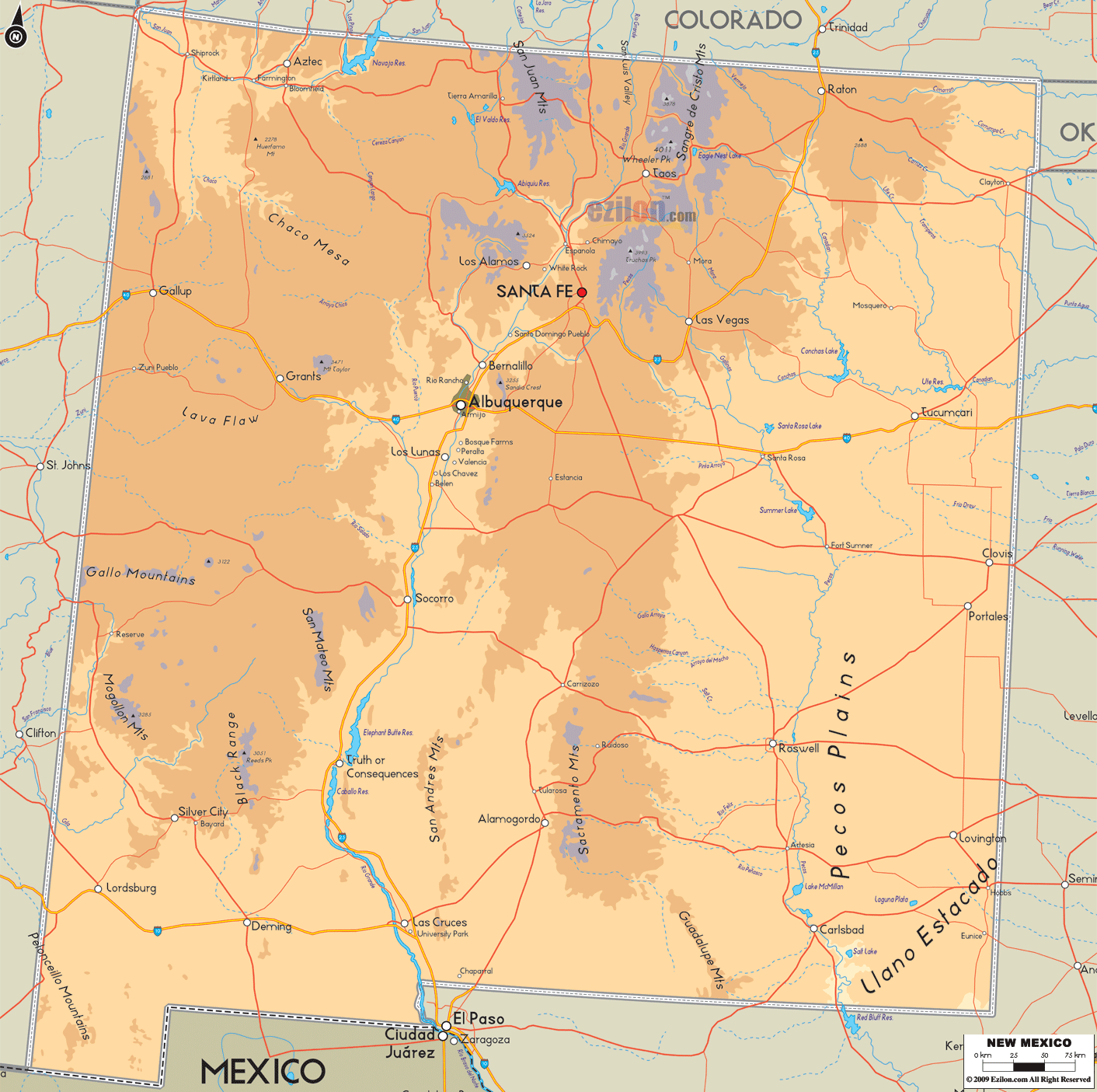
Description: The Physical map of New Mexico State, USA showing major geographical features such as rivers, lakes, topography and land formations.
A physical map of New Mexico is one of the best tools for understanding how this large Southwestern state stretches from snow-capped peaks on the Colorado border down to desert valleys on the Mexican frontier. At first glance, this geographical map of New Mexico looks like a simple square, but when you look closely at this detailed map, you notice a patchwork of plateaus, mountains, basins, river valleys, lava flows, and plains. These landforms explain why the climate, scenery, and travel routes change so quickly as you move across the state.
Our map places New Mexico between Colorado to the north, Arizona to the west, Texas and a corner of Oklahoma to the east, and Mexico to the south. The boundary lines are straight for most of the state, which makes the relief shading stand out even more. You can clearly see how the high country of northern New Mexico drops into central basins before tilting up again into the Sacramento and Guadalupe Mountains near Texas and the Llano Estacado plateau on the southeastern edge.
Start at the top of the map on the Colorado border. Here, you see darker-shaded terrain and closely packed contours showing the Sangre de Cristo Mountains and other ranges of the southern Rocky Mountains. Towns such as Raton and Chama appear in narrow valleys and passes. This region features some of New Mexico's highest elevations, and the physical map shows how peaks and ridges dominate the northern skyline.
Moving slightly south, the relief softens into upland plateaus cut by rivers and canyons - Santa Fe, located in a transitional zone on the base of the Sangre de Cristo Mountains. The map shows Santa Fe's location on higher ground in the northeast, explaining the city's cooler weather and big views of the mountains. To the northwest, you see darker patches marking the Jemez Mountains and the volcanic domes around Los Alamos, where steep slopes and deep canyons cut into the plateau.
Running from north to south down the middle of the map is the striking blue line of the Rio Grande, New Mexico's main river. The river flows in from Colorado through the San Luis Valley and west of Taos before flowing through the broad basin that contains Santa Fe and Albuquerque. This long valley is not too great a difficulty to follow. The physical map shows lighter shading in the Rio Grande floodplain and darker tones on the bordering plateaus.
The Albuquerque area appears clearly about halfway down the state, marked as a major city along the Rio Grande. You can see how it sits in the Albuquerque Basin, a vast lowland ringed by higher terrain. To the east of the city, the map shows the Sandia Mountains rising abruptly. Their steep front and high elevation are evident in strong relief shading, which explains why this area supports forests and ski slopes even though the surrounding desert is much drier.
Further south along the river, the map labels towns like Los Lunas, Socorro, Truth or Consequences, and Las Cruces. Each one appears in the river valley where irrigation and travel routes cluster. The physical map of New Mexico makes it clear that the Rio Grande corridor is the state's central north-south spine of settlement, agriculture, and transportation.
When you look to the west of the Rio Grande, you step into an area of mesas, volcanic fields, and forested ranges that is part of the southern Colorado Plateau and Basin and Range province. Towns like Gallup, Grants, and Silver City are scattered through a rugged landscape.
Close to Grants, on the map, the Lava Flow is marked, along with Chaco Mesa and a few other features indicating areas of dark volcanic rock. The shading also has possible insight into the elevation of these lava fields, which may sit on high plateaus rather than low plains. To the southwest, the Gallo Mountains, Black Range, and Mogollon Mountains are shown as broken ranges with deep canyons and steep ridges, indicating some of the wildest backcountry in New Mexico.
The physical map also reveals how roads thread their way through this high relief. Highways often follow valleys and passes between ranges instead of crossing the highest areas. This is valuable for travelers who want to plan scenic drives or avoid steep mountain routes in winter.
On the eastern side of the map, the land changes character again. The shading becomes lighter and more uniform, showing the flat to gently rolling Llano Estacado and Pecos Plains. Cities like Clovis, Portales, and Hobbs lie in this region, along with smaller towns such as Fort Sumner and Santa Rosa. The map labels the Pecos River and several smaller streams that cut shallow valleys into the plains.
This part of New Mexico lies on the Great Plains, and the physical map makes it clear that elevation is lower and relief is gentler here than in the mountains to the west. Farming and ranching dominate the land use, with long straight roads that fit the gridlike pattern of the plains. The map helps geography students see the contrast between the eastern plains and the central and western basins and ranges.
At the bottom edge of the map, the Rio Grande passes through Las Cruces and then slips into El Paso and Ciudad Juárez on the border with Mexico. Here, the relief shading softens into basins surrounded by isolated ranges. You can see the San Andres Mountains and the Organ Mountains rising to the east, forming a dramatic wall above the desert floor.
The map suggests the Guadalupe Mountains and some nearby ridges that lie over the Texas border. The highlands and the adjacent basins and valley of the Chihuahuan Desert give way to a suite of playas, alluvial fans, and sharp limestone peaks. Travelers can see on the physical map that the main routes linking Las Cruces and El Paso with Central and Eastern New Mexico follow valleys and passes.
Even though New Mexico is dry, the physical map reveals the life-giving rivers and reservoirs that support its flow and life. Apart from the Rio Grande, the Pecos River flows through the eastern part of the state, linking the communities of Roswell, Artesia, and Carlsbad before entering Texas. West of the Rio Grande, smaller rivers and arroyos such as the Gila, San Francisco, and Mimbres are visible where they cross roads or pass near towns.
The map also marks reservoirs such as Elephant Butte Reservoir along the Rio Grande and smaller lakes near Roswell and other towns. These blue patches stand out against the warm desert tones, helping readers quickly spot places where boating, fishing, or irrigation might be important.
Because this physical map of New Mexico combines terrain, rivers, roads, and cities on one sheet, it serves multiple audiences. Residents can use it to see how their hometown fits into the broader geography of mountains, plateaus, and deserts. For example, someone in Albuquerque can see how close they are to the Sandia Mountains and how the Rio Grande shapes their valley. A resident of Roswell can see their position on the Pecos Plains and how far the mountains lie to the west.
Visitors may follow the Rio Grande corridor from Colorado to Mexico, plan trips from Santa Fe to Taos or from Albuquerque to Gallup and Grants, or stroll scenic routes through the Mogollon Highlands and Gila region. The roads that cut through rough country and those that run along flat plains are indicated.
Geography students and professors can use the New Mexico geography map to learn about tectonic plates, volcanism, and erosion. Despite being a single state, regional variation is strongly reflected in the contrasts between the Colorado Plateau-style mesas and lava flows in the west, the Rio Grande rift valley, and the plains in the east.
It shows New Mexico’s mountains, plateaus, deserts, rivers, and valleys, along with major cities, towns, and highways that follow the natural landforms.
Elevation is shown with shaded relief and color changes, so high mountain areas look darker and more textured while basins and plains appear lighter and smoother.
The Rio Grande Valley runs from the northern border with Colorado down the middle of the state through cities like Santa Fe, Albuquerque, Socorro, Truth or Consequences, and Las Cruces.
The map highlights the Sangre de Cristo Mountains, Jemez Mountains, Sandia Mountains, Black Range, Mogollon Mountains, San Andres Mountains, and Sacramento Mountains.
Northwestern New Mexico appears as a broad, elevated plateau with gentle relief, mesas, and lava fields near towns such as Gallup and Grants.
Albuquerque lies near the center of the state on the Rio Grande, in a wide basin with the Sandia Mountains rising sharply to the east.
Santa Fe is shown north of Albuquerque at the base of the Sangre de Cristo Mountains, where high peaks meet the upper Rio Grande Plateau.
The map shows parts of the Chihuahuan Desert in southern New Mexico, along with high desert basins and arid plateaus across much of the state.
The eastern edge of New Mexico, around towns like Clovis and Portales, is drawn as flat to gently rolling plains that form part of the Llano Estacado and Pecos Plains.
The southern border is shown along the Rio Grande near Las Cruces and El Paso, connecting to Ciudad Juárez in Mexico, while the eastern border follows straight lines between New Mexico and Texas and a small section with Oklahoma.
The Pecos River, Gila River, San Juan River, and several smaller streams and arroyos are marked where they cross roads or pass near towns.
The Pecos River runs through eastern New Mexico, passing near Santa Rosa, Fort Sumner, Roswell, and Carlsbad before flowing into Texas.
Travelers can follow the Rio Grande corridor, choose routes across the plains or through mountain passes, and spot scenic areas like the Mogollon highlands or northern plateaus.
It shows alternating low basins and narrow ranges across southern and central New Mexico, especially west of the Rio Grande where the landscape is broken and rugged.
Las Cruces is marked near the southern Rio Grande, north of El Paso, with the San Andres and Organ Mountains rising to the east.
Near Grants and in parts of western New Mexico, dark shaded patches labeled as lava flows indicate volcanic fields atop the plateau.
Forested areas are suggested by high elevation shading in the Sangre de Cristo Mountains, Jemez Mountains, Black Range, Mogollon Mountains, Sacramento Mountains, and other uplands.
Students can identify landform regions, trace rivers, compare plateaus and plains, and connect city locations with their surrounding mountains and basins.
By comparing high mountains, mid elevation basins, and low desert plains, the map helps explain cooler mountain climates, dry basins, and warmer southern valleys.
The Gila and Mogollon region lies in southwestern New Mexico, southwest of Socorro and northwest of Las Cruces, shown as rugged highlands with canyons.
Yes, hikers can use it to find mountain ranges, canyons, and high plateau edges, then match them with towns and roads that provide trail access.
Broad areas of warm colors, sparse surface water, and clustered rivers show that most of New Mexico is a high desert landscape with limited rainfall.
Cities such as Clovis, Portales, and Roswell appear on the eastern plains, along with smaller towns that follow the Pecos River and local highways.
Major highways are drawn as bold lines that follow river valleys or cross passes between ranges, linking cities and regions across the state.
It shows that most large cities and towns line up along the Rio Grande corridor and the eastern plains, while huge areas of mountains and plateaus remain sparsely populated.
Yes, it is ideal for school work because it clearly displays mountains, rivers, plateaus, plains, cities, and neighboring states in one view.
Researchers can use it as a base for studying land use, water resources, transportation, and environmental patterns across different landform regions.
The map labels Colorado, Arizona, Texas, and a corner of Oklahoma, along with border cities like El Paso, helping users see New Mexico’s regional position.
Yes, it provides an excellent overview of major routes and terrain patterns, which can be combined with detailed road maps or GPS tools for navigation.
No. The New Mexico physical map is provided for on screen viewing only, and printing, copying, or redistributing the map in any form is not allowed.

Counties and Road Map of New Mexico
Counties and Road map and map image of New Mexico.

Regional Directory of Canada
Information and guide about Canada and website listing.

Regional Directory of United States of America
Information and guide about United States of America and websites with American topics.

Regional Directory of Europe
Information and guide about Europe and websites with European topics.

Regional Directory of Australia
Information and guide about Australia and websites with Australian topics.