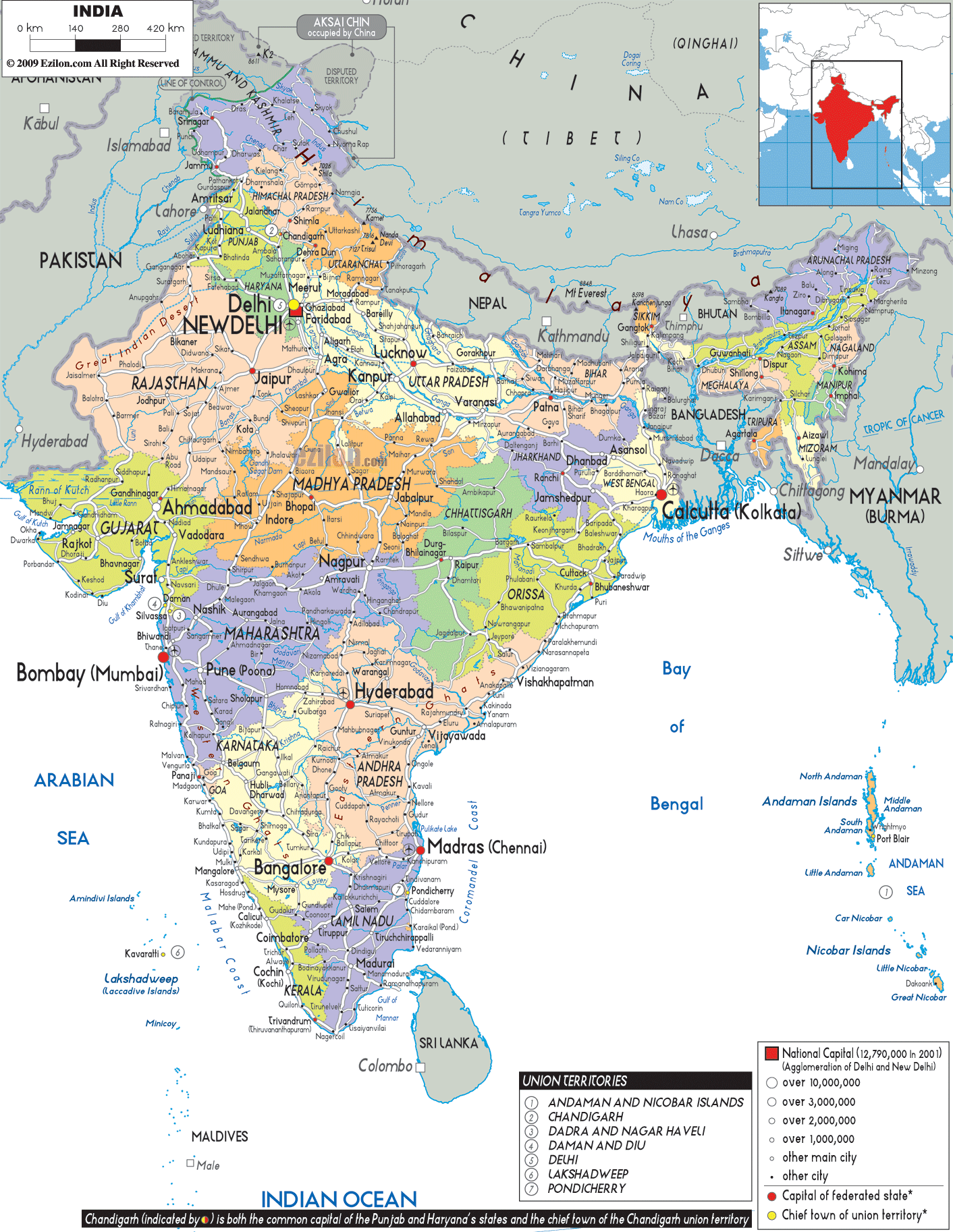
Description: Detailed large political map of India showing names of capital city, towns, states, provinces and boundaries with neighbouring countries.

The map of India with cities, the map of India with towns, and the map of India with regions perfectly map out the lavish political map you are looking at. The detailed map shows the different color states and union territories, with clear boundaries, the capital city, major cities, other towns, symbols of the national capital, and sea labels.
Since this is a political representation rather than a physical one, it mainly shows administrative units, city names, regional labels, and international borders. Hence, this is one of the best map formats for understanding how India is organized and how people are dispersed across the subcontinent.
The map of India, with regions, divides the country into different states and union territories, and a full set is represented here with color bands and border outlines. States like Maharashtra, Bihar, West Bengal, Tamil Nadu, Rajasthan, Karnataka, and Gujarat border smaller states like Goa, Sikkim, and Tripura. Union territories like Delhi, Chandigarh, Jammu and Kashmir, Ladakh, Puducherry, Andaman and Nicobar Islands, and Lakshadweep are recognized as union territories.
A myth explains the symbols for the national capital, state capitals, big cities, and other towns, so that anyone reading the map of India with cities can easily identify the hierarchy of settlements.
India is bordered by countries and oceans, as shown clearly on the map of India. To the northwest are Pakistan and Afghanistan; to the north are China, Nepal, and Bhutan; to the east are Bangladesh and Myanmar; and to the south are Sri Lanka and the Maldives across the Arabian Sea, the Bay of Bengal, and the Indian Ocean. The Andaman and Nicobar Islands, being an extensive offshore territory, are shown in insets with the names of settlements and district headquarters.
The National Capital Territory of Delhi, in terms of its geographical location, lies near the northern center of the Map of India with cities. The national capital, Delhi, is marked on the map with a special symbol.
The map depicts Delhi as a small territory situated between Haryana and Uttar Pradesh. The neighboring cities like Gurugram, Faridabad, Ghaziabad, and Noida are labeled on the map to show the larger NCR and so on. Roads leaving Delhi towards Jaipur, Chandigarh, Lucknow, and Agra help the reader understand how Delhi connects to major regional hubs in all directions.
An India map showing cities and their surrounding areas is extremely convenient for many travelers and students looking for the same. It clearly explains that Delhi is at the junction of the northern plains, the western desert states, and the Himalayan foothills, which is important in geographical and transport planning.
The map of India with cities and regions shows north India, which spreads over the Indo-Gangetic plain and the foothills of the Himalayas on the north side of Delhi. Punjab is in the northwest, while its capital, Chandigarh, which is also the capital of Haryana, is located between the two states.
In Punjab, cities like Amritsar, Ludhiana, and Patiala have been marked. In Haryana, Ambala, Karnal, Rohtak, Hisar, and Gurgaon have been marked. All these cities have been marked with dots of different sizes.
The hill states of Himachal Pradesh and Uttarakhand appear as smaller color patches in the northeast of Delhi. Their capitals, Shimla and Dehradun, appear, and Dharamshala, Mandi, Nainital, and Haridwar also appear.
In the east, the large state of Uttar Pradesh dominates the northern plains, with the capital, Lucknow, and major cities such as Kanpur, Varanasi, Agra, Allahabad (Prayagraj), Meerut, and Gorakhpur clearly shown. The Map of India with towns and villages depicts the relative densities of the settlement network across northern India, in contrast to the hill areas to the north of the map.
The western side of India comprises mainly Rajasthan and Gujarat, as shown on the Map of India with regions. The Map of Rajasthan shows the state, with its capital, Jaipur, on the eastern side. Indication of other key cities, such as Jodhpur, Udaipur, Ajmer, Bikaner, and Kota, is also provided.
To the southwest, Gujarat lies along the Arabian Sea, with its capital Gandhinagar near the major commercial city Ahmedabad, and other cities such as Surat, Vadodara, Rajkot, Bhavnagar, and Jamnagar are important.
The territory of Dadra and Nagar Haveli lies on the western coast, between Maharashtra and Gujarat, where the Arabian Sea and the Gulf of Khambhat meet. Further west along the coast is Daman and Diu, both located on the western coast of India, in the Arabian Sea.
Lakshadweep is shown as a cluster of small islands in the Arabian Sea, much before the Maldives. As visitors view the India Map Cities layer from the west, it becomes clear that major ports and industrial centers like Mumbai and Kandla are located relative to the desert areas of Rajasthan and the peninsular states to the south.
Located in the center of the Map of India, Madhya Pradesh is one of the largest states by area, with its capital, Bhopal, and major cities such as Indore, Gwalior, Jabalpur, and Ujjain. To the east, the state of Chhattisgarh, which emerged from Madhya Pradesh in 2000, is shown, with its capital, Raipur, and cities such as Bilaspur, Durg, and Korba. Road lines connecting the cities show the major transport routes. The political map of India with regions includes the central states, which illustrate how they balance large interior territories with major river valley corridors and plains where cities have grown.
Bihar and Jharkhand are shown on the Map of India, located to the east of Uttar Pradesh and Madhya Pradesh. The Ganges River city of Patna is the capital of Bihar, 1 of the 3 City centers in the state. Gaya, Bhagalpur, and Muzaffarpur are also the source centers of the state of Bihar. The state of Jharkhand is situated just below Bihar, with its capital, Ranchi. Other major towns in Jharkhand include Jamshedpur, Dhanbad, and Bokaro Steel City.
The capital of West Bengal is Kolkata. It is located where the Ganga delta ends. Siliguri, Asansol, and Durgapur are also cities in the state.
This Siliguri corridor, through the narrow then, connects India with the North-East, the states of India Assam, Meghalaya, Nagaland, Manipur, Mizoram, Tripura, and Arunachal Pradesh, along with its capital, Delhi. Dispur (Guwahati area), Shillong, Kohima, Imphal, Aizawl, Agartala, and Itanagar are all mapped as the North-Eastern towns and villages mapping.
The part of the map of India with cities and states shows that the southern half is dominated by states fringing the Arabian Sea and the Bay of Bengal. Maharashtra is located along the west coast, with the capital, Mumbai (Bombay), designated as India's financial center and one of its largest cities.
At the same time, Pune, Nagpur, Nashik, and Aurangabad are shown as other major urban nodes. Situated south of Maharashtra, the small coastal state of Goa is marked by its capital, Panaji, a major tourist and port city.
Further down the peninsula, Karnataka is represented by its capital, Bengaluru (Bangalore), and cities such as Mysuru, Mangaluru, Hubballi, and Belagavi. At the same time, along the east coast, Andhra Pradesh and Telangana share the Deccan region, with Hyderabad serving as the capital of Telangana and the Amaravati / Vijayawada area representing the administrative core of Andhra Pradesh.
At the south end, the Tamil Nadu capital, Chennai (Madras), and towns Coimbatore, Madurai, Tiruchirappalli, and Salem, and Kerala, with the sea towns Thiruvananthapuram, Kochi, and Kozhikode, complete the mainland. This southern cluster shows how the map of Indian cities highlights coastal metropolitan zones linked by corridors across the peninsula.
As you follow India's map from north to south, marking the cities and towns, you start in the foothills of the Himalayas in Jammu and Kashmir, Ladakh, Himachal Pradesh, and Uttarakhand. You come across names like Leh, Srinagar, Jammu, Shimla, and Dehradun on the northern border.
As you move down, you come across the well-identified flatlands of Punjab, Haryana, Delhi, Uttar Pradesh, and Bihar. The map shows long strings of cities, including Amritsar, Ludhiana, Delhi, Agra, Kanpur, Lucknow, Patna, and Gaya.
The South Indian railway map starts with Mahad, Palghar, and Thane, continuing southwards. Next, we proceed to the Mumbai-Pune corridor, which serves as the most important entry point to India's hinterland. The vital Pune–Krishna corridor likewise functions as an entry barrier to Karnataka. This mental excursion shows how the political map is an upper-level travel planning tool, though it does not show detailed highways.
The map of India, with cities and regions, also accurately situates the nation within its international context. The land frontiers with Pakistan, China, Nepal, Bhutan, Bangladesh, and Myanmar are shown and labeled, with the publisher's convention for disputed areas, such as Aksai Chin and part of Jammu and Kashmir, also marked.
The Indian Ocean, in the south seas to the east of India, which is clearly labeled a major water body – the Arabian Sea to the west, the Bay of Bengal to the east, and the Indian Ocean to the south - is clearly labeled, with Sri Lanka and the Maldives shown as nearby island nations.
Students or roamers usually see a map of India with cities and towns marked on it. It provides domestic sites such as Kolkata, Chennai, and Kochi with a broader regional context for South Asian trade routes and cross-border linkages.
This political Map of India with towns and villages uses the size of circles in its legend to show different population categories, from cities with more than 10 million residents to smaller towns. Cities like Delhi, Mumbai, Kolkata, Bengaluru, Chennai, and Hyderabad appear with the largest symbols, while million-plus cities like Ahmedabad, Pune, Surat, Kanpur, and Jaipur use slightly smaller circles. At the national and local levels, we see below them mid-sized cities and district headquarters as smaller, dot-sized indicators of how urban India is structured.
This ranking is helpful for readers looking specifically for an India map with cities that shows the locations of major job centers, transport hubs, and regional capitals. At the same time, it provides geography students with a visual depiction of India's urban system.
The Map of India with cities and towns provides a single view of the states, union territories, cities, towns, borders, and seas. Thus, it has many uses. The states and UTs their citizens live in, their state capitals, and how cities are connected along major corridors, for instance, the Delhi–Mumbai, Delhi–Kolkata, or Bengaluru–Chennai.
Travelers can use the map of India showing cities and regions to create itineraries that flow from one metropolitan area to another, with stops in smaller heritage towns, using the city labels as markers for planning their journey.
The map of India with regions is a must-have reference material for geography students. It contains the 28 states and 8 union territories of India, their capital cities, and their relations with each other and neighboring countries.
Since this political map excludes rivers and mountains, it keeps the focus on human geography, i.e., administrative boundaries, population centers, transport lines, etc., which can then be coupled with physical maps for classroom activities.
India is located in South Asia between the Arabian Sea, Bay of Bengal, and the Indian Ocean.
The political map shows 28 states and 8 union territories across India.
Delhi is shown as the national capital territory near northern India.
Neighboring countries shown include Pakistan, Afghanistan, China, Nepal, Bhutan, Bangladesh, Myanmar, Sri Lanka, and the Maldives.
The map shows the Arabian Sea, Bay of Bengal, and Indian Ocean surrounding India.
Major cities shown include Delhi, Mumbai, Kolkata, Bengaluru, Chennai, Hyderabad, Ahmedabad, Pune, Jaipur, and Lucknow.
Delhi is located in northern India between Haryana and Uttar Pradesh.
Cities surrounding Delhi include Gurugram, Faridabad, Ghaziabad, and Noida.
Northern states shown include Punjab, Haryana, Himachal Pradesh, Uttarakhand, and Uttar Pradesh.
Punjab cities shown include Amritsar, Ludhiana, Patiala, and Chandigarh.
Chandigarh is located between Punjab and Haryana and serves as the capital of both states.
Haryana cities shown include Ambala, Karnal, Rohtak, Hisar, and Gurgaon.
The hill states shown include Himachal Pradesh and Uttarakhand.
Major Uttar Pradesh cities shown include Lucknow, Kanpur, Agra, Prayagraj, Meerut, Varanasi, and Gorakhpur.
Western states shown include Rajasthan and Gujarat.
Rajasthan cities shown include Jaipur, Jodhpur, Udaipur, Ajmer, Bikaner, and Kota.
Gujarat cities shown include Ahmedabad, Surat, Vadodara, Rajkot, Jamnagar, and Bhavnagar.
Lakshadweep is shown as a cluster of islands in the Arabian Sea southwest of mainland India.
Central Indian states shown include Madhya Pradesh and Chhattisgarh.
Cities shown in Madhya Pradesh include Bhopal, Indore, Gwalior, Jabalpur, and Ujjain.
Cities shown include Raipur, Bilaspur, Durg, and Korba.
Eastern states shown include Bihar, Jharkhand, and West Bengal.
Cities shown include Patna, Gaya, Muzaffarpur, Ranchi, Jamshedpur, Dhanbad, and Bokaro.
West Bengal cities shown include Kolkata, Siliguri, Asansol, and Durgapur.
Northeastern states shown include Assam, Meghalaya, Nagaland, Manipur, Mizoram, Tripura, and Arunachal Pradesh.
Southern states shown include Maharashtra, Goa, Karnataka, Telangana, Andhra Pradesh, Tamil Nadu, and Kerala.
Major southern cities shown include Mumbai, Bengaluru, Hyderabad, Chennai, Kochi, Pune, and Mysuru.
The map highlights major corridors such as Delhi-Mumbai, Delhi-Kolkata, Bengaluru-Chennai, and the Mumbai-Pune corridor.
Yes, the map helps travelers and students study states, cities, borders, regional corridors, and urban geography.
No. Printing or copying maps from this site is not permitted.

Physical Map of India
Physical map and map image of India.

Road Map of India
Road map and map image of India.

Regional Directory of United States of America
Information and guide about United States of America and websites with American topics.

Regional Directory of Europe
Information and guide about Europe and websites with European topics.

Regional Directory of Australia
Information and guide about Australia and websites with Australian topics.