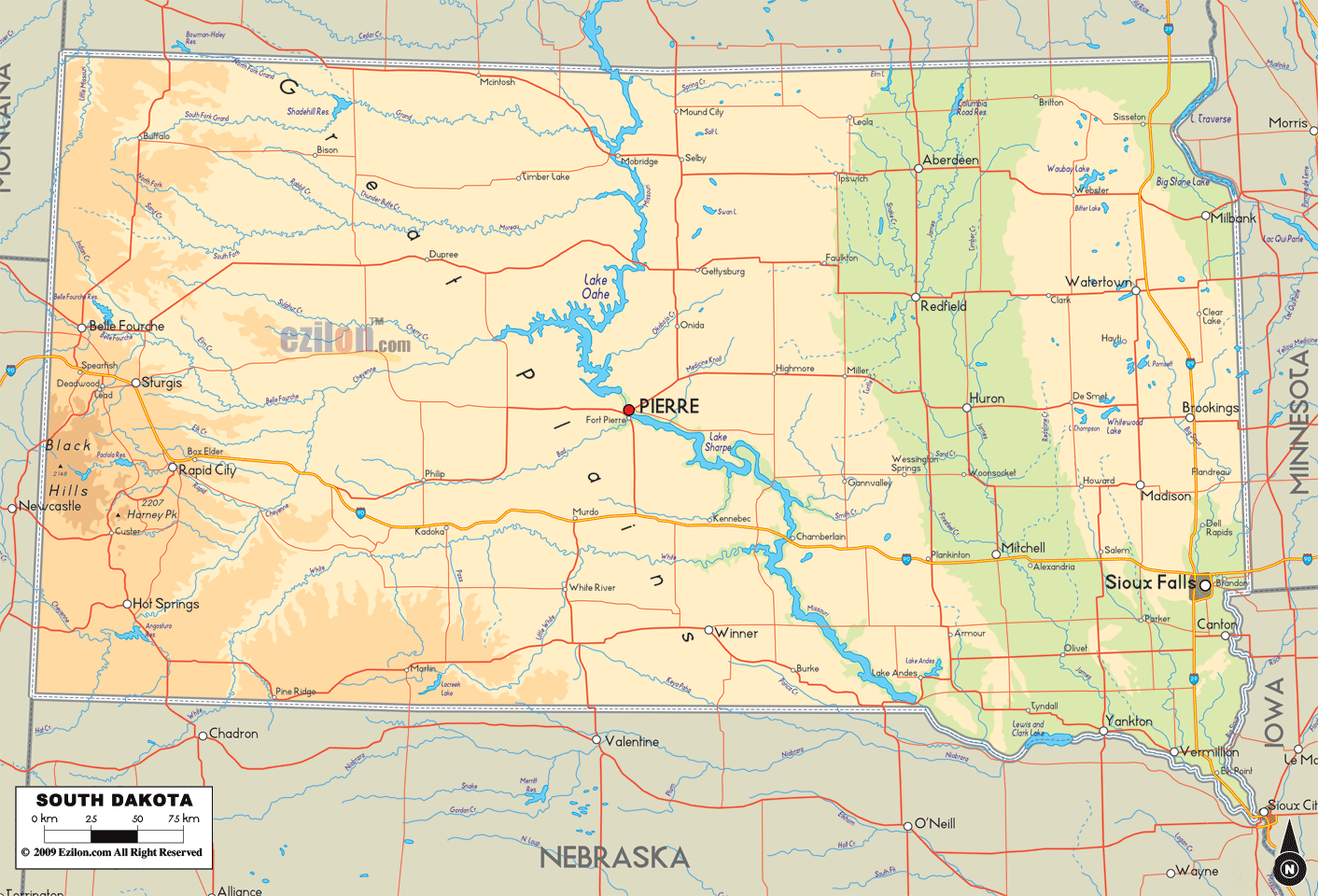
Description: The Physical map of South Dakota State, USA showing major geographical features such as rivers, lakes, topography and land formations.

Detailed Physical map of South Dakota with elevations and other topographic features such as mountains, rivers and lakes. For county boundaries, cities, and roads, see our County and Road Map of South Dakota. South Dakota borders North Dakota, Minnesota, Iowa, Nebraska, Wyoming and Montana. Our detailed map highlights two big stories. The rugged Black Hills and eroded Badlands abruptly rise from the surrounding prairie. In the west, the rugged Black Hills and the eroded Badlands increase sharply from the surrounding prairie. In the center, the broad Missouri River and its long chain of reservoirs cut a winding path from north to south. In the east, softer greens mark fertile plains and gentle uplands where many of the state's farms and most significant cities are found.
South Dakota is part of the Great Plains, yet this best map makes it clear that not all plains are the same. It is bordered by North Dakota to the north, Minnesota and Iowa to the east, Nebraska to the south, and Wyoming and Montana to the west and northwest. The precise state outline and surrounding labels on our map help readers place South Dakota within the larger central United States.
In the southwest corner of the map, near the borders with Wyoming and Nebraska, you can see a block of darker, more textured shading that marks the Black Hills. Towns such as Rapid City, Spearfish, Sturgis, Custer, and Hot Springs cluster around this rugged upland. The physical map of South Dakota shows steep slopes, narrow valleys, and higher elevations that stand out from the surrounding lower plains.
Within the Black Hills rise several well-known peaks, including Black Elk Peak, the highest point in the state, and the granite areas that host famous monuments such as Mount Rushmore. Although the actual memorial is not named on this map, the dense road network around Keystone and Custer hints at the tourist activity focused on these mountains.
The rivers and creeks flowing out of the Black Hills, such as Rapid Creek and the Cheyenne River, are drawn as bright blue lines cutting eastward into the plains. From the map, geography students can see how this isolated uplift forms the central source region for many western South Dakota streams.
To the east and southeast of the Black Hills, the shading becomes lighter but still rough, marking the broken country of the Badlands and adjoining high plains. Places such as Wall, Kadoka, Martin, and Pine Ridge lie in this belt of eroded buttes, ridges, and narrow ridgelines. On the geographical map of South Dakota, the Badlands appear where rivers like the White River and Cheyenne River have carved deeply into the soft sedimentary rocks, leaving sharp edges and colorful cliffs.
This section of the state, often called the West River, is drier than the east. Ranching and grassland dominate, as evidenced by the large ranch-style spacing of towns on the map and the vast stretches of open country between highways.
One of the most striking features on the physical map of South Dakota is the broad, blue ribbon of the Missouri River, entering the state from North Dakota in the north central area and then curving southeast before crossing into Nebraska near Yankton. The map shows several vast reservoir expansions along this river, including Lake Oahe north of Pierre, Lake Sharpe immediately downstream of Pierre, and Lake Francis Case and Lewis and Clark Lake farther south near Chamberlain and Yankton.
The state capital, Pierre, sits roughly in the center of South Dakota on the east bank of the Missouri, with Fort Pierre on the west bank. From the map, it is clear that Pierre is positioned at a key river crossing where road and rail links converge. Geography students can see how this central location helps the small capital connect eastern and western parts of the state.
To the north and south of Pierre, the land on both sides of the Missouri is shown with gentle color changes and few steep contours, indicating open rolling plains. Towns such as Mobridge, Gettysburg, Onida, Miller, and Winner lie along roads that run roughly parallel to the river. These settlements highlight how the river valley acts as a spine for transport and agriculture.
The map also marks numerous smaller lakes and reservoirs scattered across central counties, such as Lake Hiddenwood and smaller stock ponds. These are especially important in a semi-arid landscape, providing water for irrigation, wildlife, and ranching.
In the eastern third of the map, you notice greener colors and more frequent water bodies. This part of the state belongs to the glaciated plains and the Coteau des Prairies, an upland that stretches through northeastern South Dakota into Minnesota. Cities such as Watertown, Brookings, Aberdeen, Madison, and Huron lie in this region.
The South Dakota Physical Map shows the region's existing lakes. Moreover, it shows the presence of the Big Stone Lake along the Minnesota border. Finally, the map shows the existing prairie pothole lakes all over South Dakota.
These patterns make us think of the places that were hit by glaciers earlier. The ice left behind depressions, which then filled with water. For bird watchers and ecologists alike, this is a critical Central Flyway habitat; you can feel that from the density of blue lake symbols.
In the far southeast, along the borders with Minnesota, Iowa, and Nebraska, lies Sioux Falls, South Dakota's largest city. The map shows the Big Sioux River flowing past the town before joining the Missouri near the Iowa border. The surrounding landscape is characterized by relatively gentle plains and a dense road grid, marking some of the most productive farmland in the state.
Communities such as Yankton, Vermillion, Mitchell, and Madison appear along the lower Missouri and its tributaries. This is East River country, where deeper soils and slightly wetter conditions support corn, soybeans, and other row crops. Our detailed map helps users see how the towns align with rivers, rail lines, and major highways, including Interstate 29 running north-south and Interstate 90 cutting east-west across the state.
Overall, South Dakota's climate is continental, with cold winters and warm summers, but the state's physical map does not explain regional differences. The western area near the Black Hills and Badlands is drier, windier, and has a larger temperature range. In the central parts around the Missouri River, a mix of western and eastern patterns prevails. The eastern plains are quite humid and receive more rainfall, which fits well with the heavy agricultural land use seen around Sioux Falls and Watertown.
By combining climate data with topography, readers can see why ranching is king in West River counties and intensive farming is spreading over the eastern half of the state.
The map shows major highways, including Interstate 90, which runs east-west from Rapid City through Mitchell to Sioux Falls, and Interstate 29, which runs north-south along the eastern border. These routes closely follow the easier terrain of open plains and major river valleys. Secondary highways radiate out from Sioux Falls, Rapid City, and Pierre to smaller county seats.
This pattern of lines on the geographical map of South Dakota illustrates how transport networks adjust to landforms. Highways skirt the roughest parts of the Badlands and the steep edges of the Missouri valley, while bridges appear at key crossing points like Pierre, Chamberlain, and Yankton.
Several Native American reservations and protected areas lie within the state. Areas around Pine Ridge, Rosebud, and other reservations are visible as clusters of towns and roads in southwestern and south-central South Dakota. The Badlands National Park area near Wall and Interior, and parts of the Black Hills National Forest, stand out for their rugged terrain and low road density.
Outdoor travelers can use the map to locate gateways to popular areas such as Custer State Park, Wind Cave National Park, and the Badlands region by checking where the roads approach the more rugged shading west of the Missouri.
Residents can use this best map of South Dakota to understand how local communities fit into the statewide picture. A student in Sioux Falls can trace the route to Rapid City and see that the journey crosses several major river systems and an entire climate gradient. A learner in Rapid City can follow the Missouri River north to Lake Oahe and then east into the glaciated plains.
Teachers can plan lessons in which students recognize the Black Hills, Badlands, Missouri River, Coteau des Prairies, and central cities, and analyze how the resources of these features affect farming, tourism, and settlement.
For travelers, the physical map helps plan scenic routes. A visitor might start in Sioux Falls, follow Interstate 90 to Mitchell, then continue west toward Wall and the Badlands before reaching Rapid City and the Black Hills. Along the way, they can stop at viewpoints over Missouri River reservoirs such as Lake Francis Case and Lake Sharpe.
Because the map clearly labels lakes, rivers, and highways, it works well alongside digital navigation tools. You can choose where to leave the main road for a quieter drive through river valleys or prairie towns simply by scanning the map.
Our South Dakota map is provided for online viewing, study, and trip planning only. Users must respect the no-printing-or-copying rule that applies across the site. That means not printing the image, not downloading it, and not reusing it on other websites, in documents, or in presentations. Instead, visitors should return to the page whenever they need to view the map again.
It highlights the Black Hills in the southwest, the Badlands and western high plains, the Missouri River valley through the center and the glaciated eastern plains.
By following highways and rivers on the map you can see how to drive from Sioux Falls to Rapid City, where to cross the Missouri River and which towns make good overnight stops.
North Dakota lies to the north, Minnesota and Iowa to the east, Nebraska to the south and Wyoming and Montana to the west and northwest.
The Black Hills lie in the far southwest near Rapid City and Hot Springs and they are important for tourism, mining history, forests and mountain recreation.
The Missouri River is the dominant feature, joined by the Cheyenne, White, James and Big Sioux rivers plus many smaller streams and creeks.
It forms a wide north south corridor with long reservoirs like Lake Oahe and Lake Sharpe, visually separating West River ranch country from East River farmland.
Key lakes include Lake Oahe, Lake Sharpe, Lake Francis Case and Lewis and Clark Lake on the Missouri plus many smaller prairie lakes in the northeast.
The Badlands lie east and southeast of the Black Hills near Wall and Interior, where deeply eroded cliffs and buttes cut into the prairie.
It is an upland in northeastern South Dakota, shown as a slightly higher green band with many small lakes around cities like Watertown and Aberdeen.
Black Elk Peak rises to more than 7,200 feet in the central Black Hills southwest of Rapid City, making it the highest point in the state.
Western areas are drier and windier, central counties feel more mixed and eastern plains are somewhat wetter, which supports more intensive farming.
Rapid City sits on the eastern edge of the Black Hills, Pierre lies on the Missouri River in the center and Sioux Falls is in the far southeast near Minnesota and Iowa.
Interstate 90 runs east west across the middle of the state and Interstate 29 runs north south along the eastern side, with other highways linking to Nebraska and Wyoming.
They can look for shaded highlands, river valleys and limited road networks on maps to locate places like the Black Hills, Badlands and Missouri River bluffs.
The plains around Sioux Falls, Brookings, Watertown and Huron show dense road grids and towns, reflecting corn, soybean and small grain farming.
Reservations such as Pine Ridge and Rosebud lie in southwestern and south central areas where high plains meet Badlands and Missouri tributaries.
Color shading and relief effects indicate higher ground in the Black Hills and Coteau des Prairies and lower terrain along the Missouri valley and eastern plains.
Low river bottoms and reservoir shorelines near towns like Pierre, Chamberlain and Yankton can face flooding when river levels are high.
Large reservoirs such as Lake Oahe, Lake Sharpe, Lake Francis Case and Lewis and Clark Lake plus many northeast prairie lakes are marked as water recreation areas.
No, the map is for online viewing and study only and it must not be printed, downloaded, copied or reused in any way.
They can label the Black Hills, Badlands, Missouri River, main rivers, lakes and cities, then explain how landforms relate to farming, climate and transport.
Forested Black Hills, open prairies, Badlands cliffs and wetland lakes all suggest different habitats for species such as deer, pronghorn, waterfowl and raptors.
The drive of about 350 miles on Interstate 90 crosses Black Hills foothills, western high plains, the Missouri River valley and then the smoother eastern prairie.
Pierre stands on a terrace above the east bank opposite Fort Pierre, at a natural crossing point between rolling plains and the deep river trench.
Open plains allow strong winter winds and blowing snow, while the Black Hills receive heavier snowfall and the Missouri valley can trap cold air and fog.
It clearly places the state in the heart of the Great Plains, with long stretches of prairie, few forests outside the Black Hills and wide open horizons.
They can use the map for a big picture view of landforms and distances, then rely on GPS for turn by turn guidance to trailheads, parks and towns.
Because the western plains are drier, the reservoirs and stock dams shown on the map provide vital water for ranches, towns, wildlife and recreation.
Researchers may reference information from the maps in written work but should not copy or reproduce the map images and should always respect the no printing rule.
An updated physical map lets users see rivers, lakes, roads and regions together, giving context that complements navigation apps and guidebooks.

Counties and Road Map of South Dakota
Counties and Road map and map image of South Dakota.

Regional Directory of Canada
Information and guide about Canada and website listing.

Regional Directory of United States of America
Information and guide about United States of America and websites with American topics.

Regional Directory of Europe
Information and guide about Europe and websites with European topics.

Regional Directory of Australia
Information and guide about Australia and websites with Australian topics.